
When MES and ERP Stop Agreeing
MES says the batch is complete. ERP says it's still open. No alarm fires. The plant quietly stops trusting its own data. How AI-assisted integrity monitoring catches what uptime checks miss.
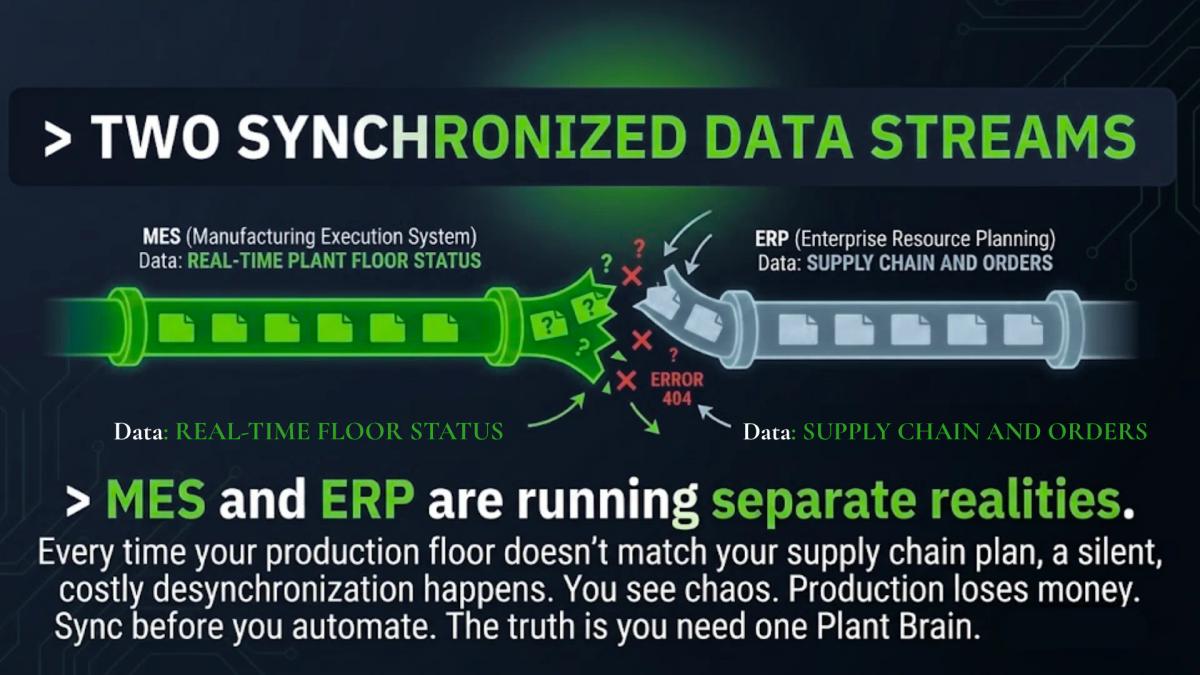

How AI-assisted data integrity monitoring can protect production from silent system failures
Modern manufacturing runs on two systems that are supposed to speak the same language. The Manufacturing Execution System (MES) runs the shop floor. The Enterprise Resource Planning (ERP) system runs the business — orders, inventory, purchasing, planning.
When they agree, production flows. When they stop agreeing, nothing announces it.
A tank status looks different in MES than in ERP. A pallet is available in one system and blocked in the other. A batch is finished on the floor but still "open" in planning. An order is released operationally but the connected business process never caught up.
None of this triggers an alarm. It just sits there — until an operator hits a wall they didn't see coming.

The problem with silent desynchronisation
Integration failures rarely announce themselves. Interfaces keep running while individual transactions get delayed, duplicated, rejected, or processed out of sequence. That's the trap: the system looks operational. The data it's feeding you no longer is.
For manufacturing teams, this shows up as delayed production, wrong inventory visibility, blocked orders, and hours of manual reconciliation — plus the least productive kind of meeting, where operations, planning, warehouse, and IT all argue from different versions of the truth.
But desynchronisation isn't only about missing data. Sometimes both systems are working exactly as designed, and they still produce a lie.
Take unit of measure. A modern order-entry system captures customer demand in a base unit — square footage, weight, volume. The legacy ERP and the shop floor track production and inventory in packaged units — rolls, pallets, cases. Both systems are functioning correctly. Neither is broken. But if the integration layer passes raw numbers across that boundary without a dynamic conversion step, the scheduling engine reads a demand spike that doesn't exist — inflated by whatever multiple separates a roll from a square foot.
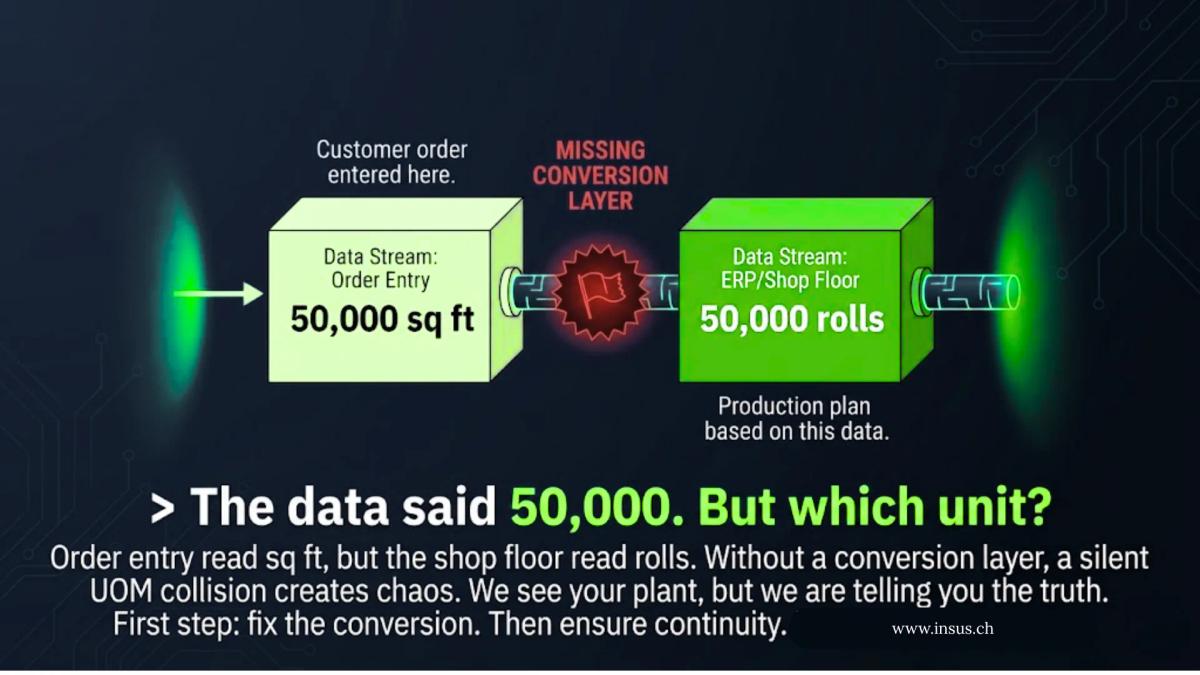
The plant reacts to a shortage that was never real. That's not a systems outage. That's a loss of trust in the data itself, and it's far more dangerous because nothing in the logs says "error.
Why traditional monitoring is not enough
Most organisations monitor whether an interface is alive — message sent, connection active, service responding. Necessary, but it tells you nothing about whether the business transaction underneath it is actually correct.
An interface can be fully online while:
- A production status is stuck.
- An inventory movement is delayed.
- A batch state disagrees between systems.
- An order update never arrives.
- Two systems each hold a different truth about the same asset.
That's the gap between monitoring system availability and monitoring data integrity. Knowing the pipes are connected tells you nothing about whether what's flowing through them still reflects reality on the floor.
And reality on the floor isn't a single snapshot — it's a moving target. Traditional monitoring checks whether today's physical inventory matches today's ERP ledger. But a SKU that looks perfectly healthy this morning can be hiding a serious deficit three weeks out in the order pipeline, invisible until it's already too late to fix cheaply.
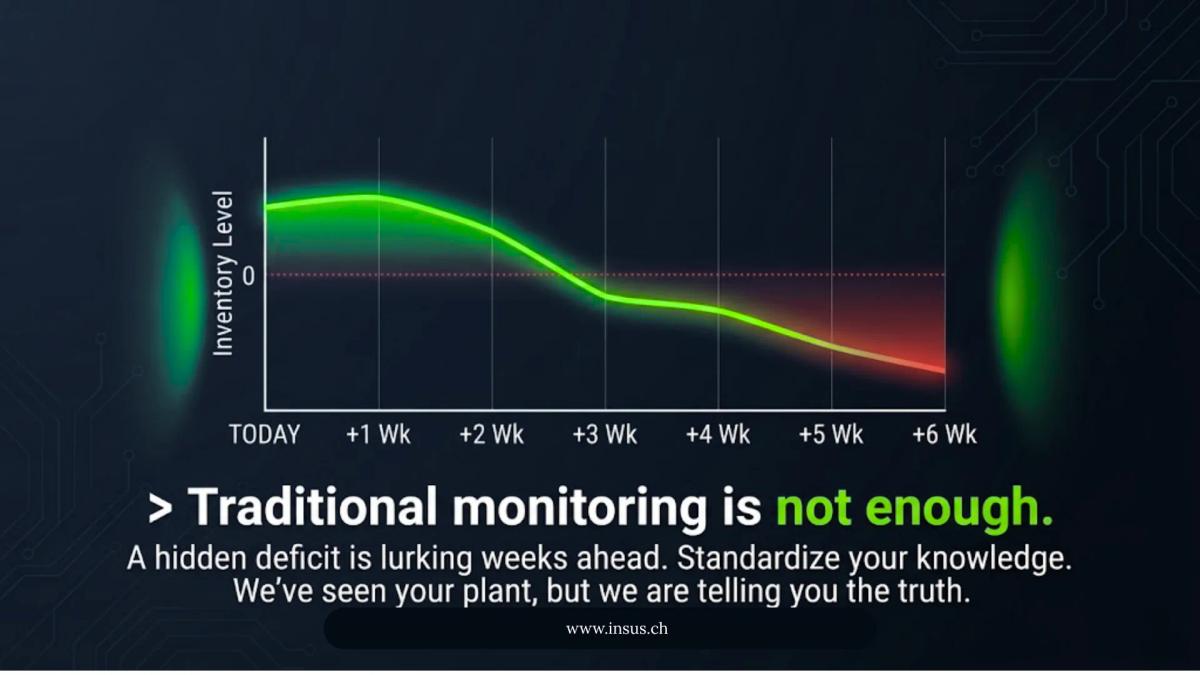
Real data integrity monitoring has to be time-phased, not just real-time. Aggregate the isolated demand sitting in regional warehouses into one enterprise-wide ledger, and a system can look weeks ahead — flagging a shortage before it happens, and adjusting production ceilings today so the floor is already absorbing tomorrow's problem instead of reacting to it next month.
What is MES–ERP data integrity monitoring
MES–ERP data integrity monitoring continuously checks the critical production, batch, inventory, and order states across MES, ERP, and connected systems — before inconsistencies become blockers.
It compares related records across systems and asks a simple question: are these states logically consistent? Has a batch marked complete in MES also closed out in ERP? Has an inventory movement landed in both systems? Did an order release actually trigger the expected production activity?
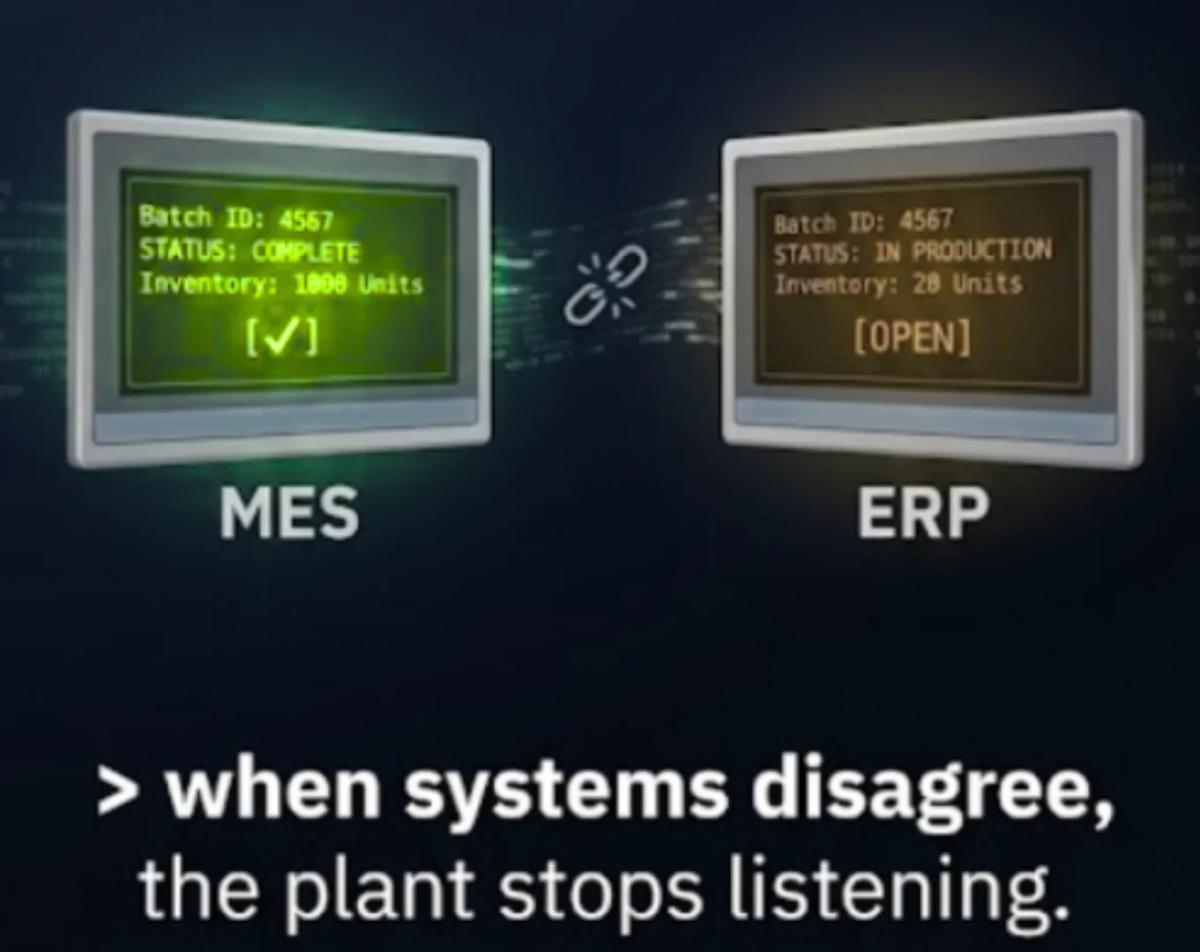
It also watches timing. A message that arrives six hours late can be just as damaging as one that never arrives at all.
How the use case works
Start by defining the business states that actually matter to production — tank status, pallet location, batch progress, material availability, order status, inventory movement. Then collect the relevant events from MES, ERP, and connected platforms, and establish the relationships between the same object across systems: the same batch, the same pallet, the same order.
This is where AI-assisted rules and anomaly detection earn their keep — not as a buzzword bolted onto a dashboard, but as a genuine reasoning layer over the mismatch. In practice, this looks like a multi-agent optimisation loop. An Analyzer agent flags the broken constraint the moment inventory and projected demand disagree. An Optimizer agent then adjusts the scheduling parameters in response — li ing a production ceiling, reordering a run, absorbing a deficit while minimising changeover cost. And because a schedule nobody understands is a schedule nobody trusts, a GenAI layer translates the "why" into plain language for the floor: exactly why this sequence, exactly what gap it's closing.
Alerts should read like an explanation, not an error code. "Batch completed in MES, still shows in-production in ERP, delay has exceeded the expected window, here's who's affected" — that's a notification a team can act on immediately, instead of a ticket they have to reverse-engineer.

From alerting to prevention
The real value shows up once the system stops just reporting problems and starts helping you prevent the next one. Historical incident analysis surfaces recurring weak points — certain transaction types failing more during shi changes, or during high-volume runs, or on a specific interface.
That's actionable. Maybe a status transition needs stronger validation. Maybe a connected service needs better retry logic. Maybe a process is missing an exception workflow entirely. Over time, this is what actually reduces the manual reconciliation tax — not more alerts, but fewer root causes.
The goal was never volume of alerts. It's catching the risks that matter, early enough to fix the cause instead of managing the symptom.
Why this matters in manufacturing
Connectivity keeps expanding across manufacturing networks. Connectivity alone guarantees nothing. Even small inconsistencies ripple into planning, execution, inventory, and — eventually — customer commitments.

Data integrity monitoring closes that gap: better visibility across MES and ERP, earlier detection of operational risk, less time spent chasing mismatched records. It also does something less obvious but just as valuable — it gives production, supply chain, and IT one shared version of the truth instead of three competing ones.
That's the real shi : from reactive troubleshooting to proactive control of the information the plant runs on.
The INSUS approach
At INSUS, we treat MES–ERP data integrity as an industrial execution challenge — not a standalone analytics exercise that lives in a slide deck.
That means the solution has to work inside what the manufacturer already has: in-house systems, legacy applications, integration layers, OT-connected environments. It has to respect how operationally critical this data is, and it cannot disrupt a live process to prove a point.
We design and deploy a monitoring layer that connects MES, ERP, and related systems, defines the logic for what a valid process state actually looks like, catches the inconsistencies, and routes the alert to the team that can act on it.
This is the broader INSUS position: we're not in the business of demonstrating a model or shipping a proof of concept that quietly dies a er the pilot. We deploy production-grade AI systems built for real industrial complexity, designed to scale across assets, plants, and operating entities — built around four non-negotiables: reliable integration, operational relevance, secure deployment, measurable value. Where it's required, the architecture can be sovereign or fully on-premise, aligned to existing governance.
A practical starting point
You don't need to monitor every data exchange on day one. Start with the transactions closest to actual production disruption — one plant, one production area, one high-impact process like batch completion, material movement, or order release.
Define the expected states, identify the data sources, set the alert thresholds, validate with production and IT. Once that logic is proven, extend it. This is how a repeatable foundation for enterprise-wide data integrity gets built — one validated process at a time, not one big-bang rollout.
Making production data trustworthy
MES and ERP are supposed to coordinate the physical and commercial sides of the same business. When they stop agreeing, the impact doesn't stay in the digital layer for long — it walks straight onto the factory floor.
Waiting for operators to report a blocked process, or relying on periodic reconciliation, is not a strategy. It's a delay tactic. What manufacturers need is earlier visibility into what's delayed, missing, or quietly contradicting itself across systems.
We don't just alert you that the ERP and MES disagree. We dynamically rebuild the time-phased master schedule to bridge the gap — and keep the machines running optimally, not just running.
From AI complexity to sovereign industrial execution — that's the distance INSUS closes for manufacturers turning disconnected system data into something they can actually build production decisions on.