
Industrial AI Use Case: Reducing Energy Consumption with OptiStudio
OptiStudio is INSUS's industrial AI optimization platform that helps energy-intensive manufacturers reduce energy consumption, improve production stability, and lower CO₂ emissions using AI-generated operating recommendations—without replacing existing automation systems.


What OptiStudio Is?
OptiStudio is INSUS’s industrial AI optimization platform designed to operate alongside existing plant automation infrastructure to optimize complex operational variables in real time.
Who It Helps
It serves energy-intensive manufacturers and utility operators- such as power plants, chemical producers, cement manufacturers, and seawater reverse osmosis (SWRO) desalination facilities- that manage high-cost, physically constrained operational loops.
What business outcome it delivers
OptiStudio reduces energy consumption, lowers overall operational costs (OpEx), stabilizes production quality, and cuts emissions through AI-generated setpoint recommendations without requiring a rip-and-replace overhaul of the plant’s Distributed Control System (DCS).
Executive Summary: Bridging the OT Optimization Gap
Industrial facilities running energy-intensive assets face high power tariffs, tight operational constraints, and strict quality requirements. Traditional automation tools manage baseline stability but lack the dynamic multi-objective capability needed to optimize real-time energy efficiency across continuous, variable inputs.
OptiStudio bridges this gap by deploying an advisory AI layer alongside existing operational technology (OT). It continuously ingests historian data, runs agentic AutoML and Bayesian optimization models, and provides supervisory setpoint recommendations to control room operators. Every output is subject to physical reliability validation and human-in-the-loop oversight to ensure zero disruption to plant safety or core DCS logic.
Across energy-intensive sectors, this approach delivers operational cost reductions of up to 10–18% (and utility cost savings of 30–40% across broader efficiency initiatives), stabilizes production parameters, and reduces carbon footprints while requiring zero upfront capital expenditure (CapEx) under INSUS's Gain-Share commercial model. Target industries include process manufacturing sectors such as Cement, Chemical Processing, Utilities & Desalination, Mining, Steel, District Cooling, and Petrochemicals.
The Core Challenge in Industrial Energy Optimization
Industrial facilities suffer from fragmented data sources, unutilized historical records, and manual operational adjustments that fail to adapt to real-time tariff and process fluctuations, directly increasing energy expenses.
Process environments incur unnecessary expenses due to structural inefficiencies across their operational architecture:
- Siloed Historians: Critical process parameters are archived in isolated databases (e.g., OSI PI, Aspen IP.21) without continuous, cross-functional modeling.
- Disconnected Data: Quality lab results, real-time telemetry, and energy grid tariffs remain unintegrated, delaying economic adjustments.
- Tribal Knowledge: Shift operators rely on manual "rules of thumb" or static Standard Operating Procedures (SOPs), leading to inconsistent shift-to-shift performance and conservative safety buffers that consume excess power.
- Fluctuating Energy Prices: Real-time variations in power tariffs or renewable availability are rarely integrated dynamically into control-room decisions.
This failure to model complex interactions dynamically forces operators to over-design processes- running pumps, kilns, or compressors above optimal energy baselines simply to protect quality margins.
Why Traditional Automation Falls Short
Standard control architectures (like APC and DCS) prioritize base-loop stability over dynamic, multi-variable economic optimization, leaving energy efficiency opportunities untapped.
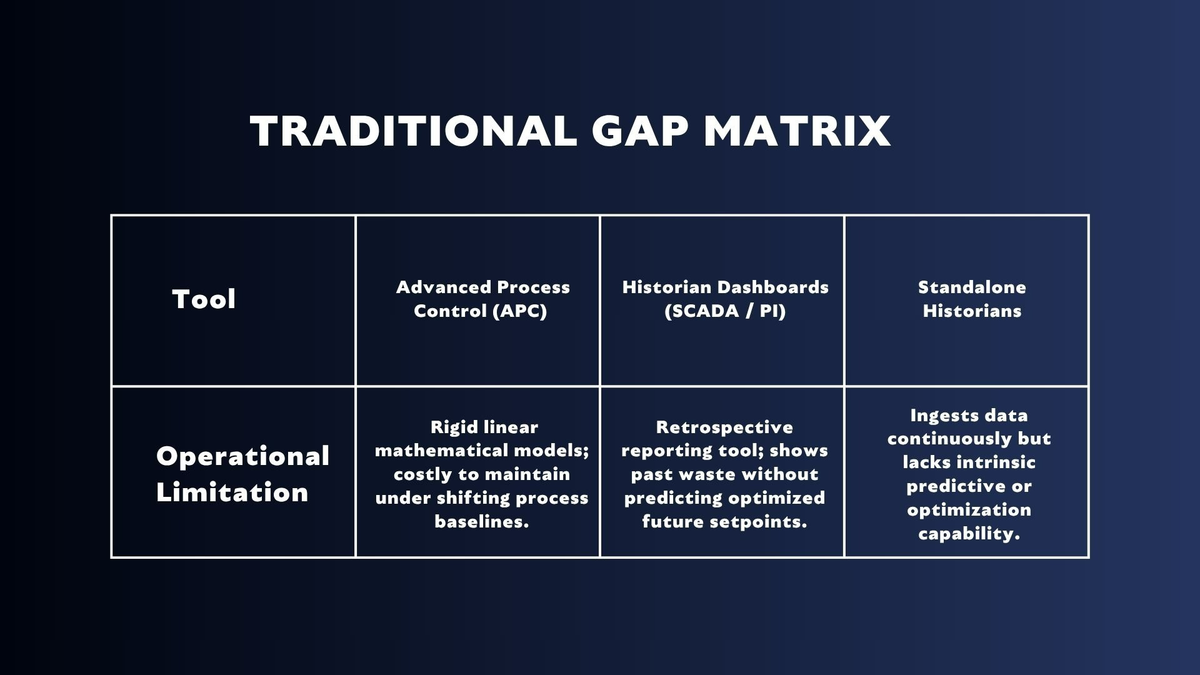
- Why APC isn't enough: Advanced Process Control relies heavily on deterministic linear models. When feedstocks, ambient conditions, or equipment wear drift, APC matrices require expensive, manual re-tuning by specialized control engineers.
- Why dashboards aren't enough: Business intelligence dashboards show that energy was wasted past-tense, but they leave the operational response entirely to operator guesswork during live shifts.
- Why historians don't optimize anything: Plant historians store billions of time-series data tags, but act strictly as passive data repositories rather than active optimization engines.
The Solution: What is OptiStudio?
OptiStudio places business outcomes—power reduction, emissions abatement, and cost minimization—ahead of technical feature sets. Rather than forcing a costly infrastructure overhaul, OptiStudio functions exclusively as an external, multi-objective advisory engine next to the DCS.
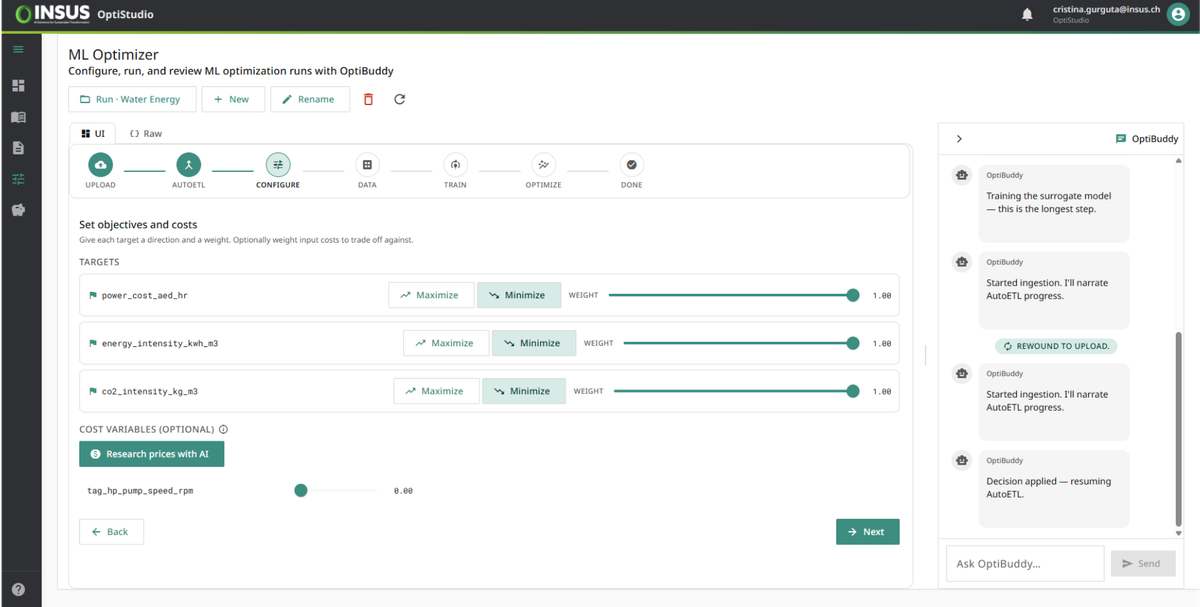
How does OptiStudio optimize operations without operational risk?
OptiStudio serves as an external, multi-objective advisory engine that reads historian streams, models optimal setpoints, and presents validated actions to human operators.
OptiStudio places business outcomes- power reduction, emissions abatement, and cost minimization- ahead of technical feature sets. Rather than forcing a costly infrastructure overhaul, OptiStudio functions exclusively as a non-intrusive advisory layer next to the DCS.
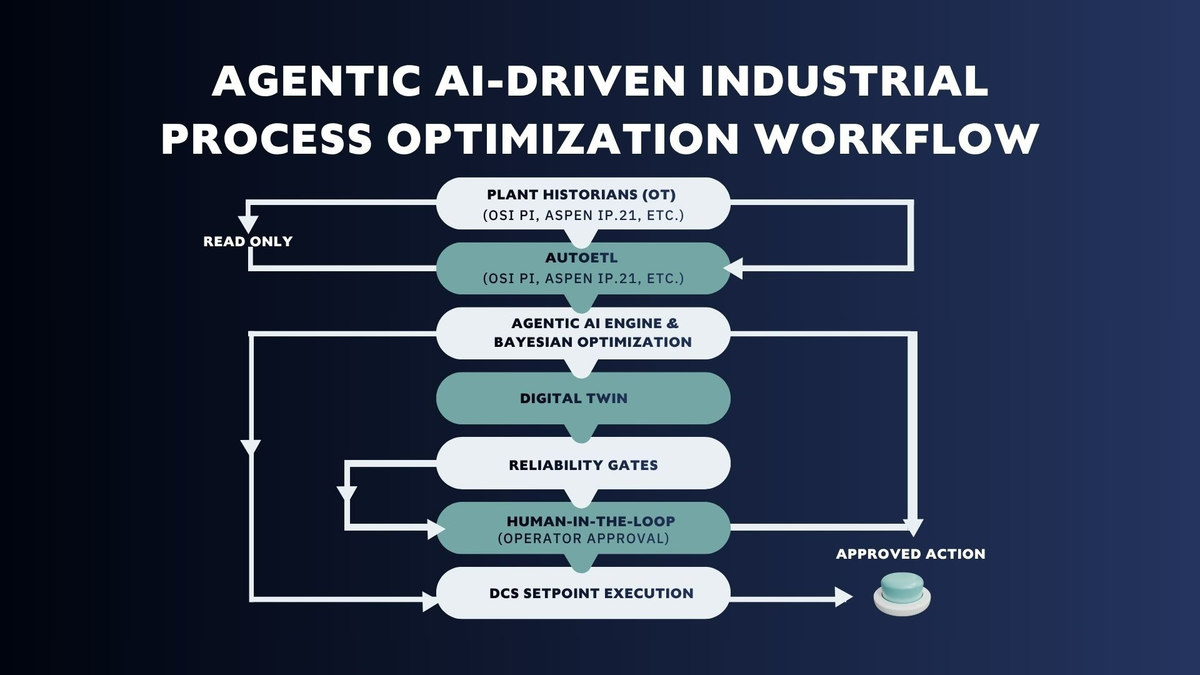
Core Engine Capabilities:
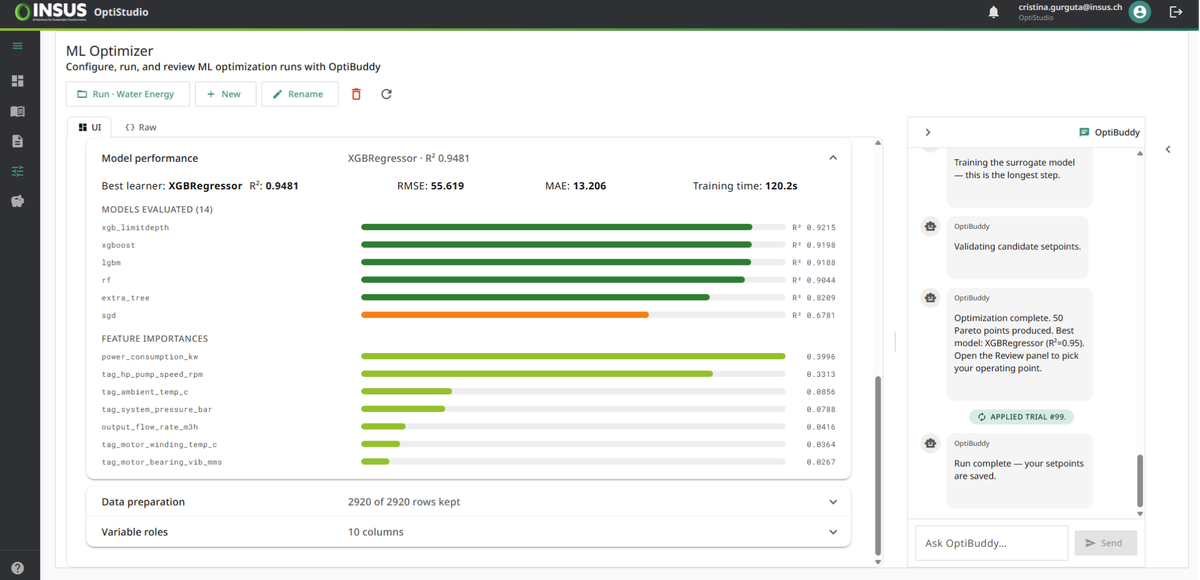
- AutoETL: Ingests raw time-series sensor data from legacy OT platforms, automatically cleaning, unifying, and structuring tag feeds into single-source-of-truth analytical tables.
- Agentic AI & AutoML: Automates feature engineering and model selection to dynamically adapt to shifting plant operational states.
- Bayesian Optimization: Solves multi-objective trade-offs simultaneously (e.g., minimizing power usage while preserving total volumetric output and product spec boundaries).
- Digital Twin Simulation: Simulates candidate recommendations within a virtual representation of the process asset prior to dispatch.
- Reliability Gates: Enforces hard boundary rules, physical safety constraints, and asset operational ranges so no invalid setpoint is ever generated.
- Human Approval Interface: Presents recommended adjustments to shift operators alongside clear, SOP-linked explainability metrics. Direct automated write-back to the PLC/DCS is explicitly blocked by design.
How OptiStudio Works
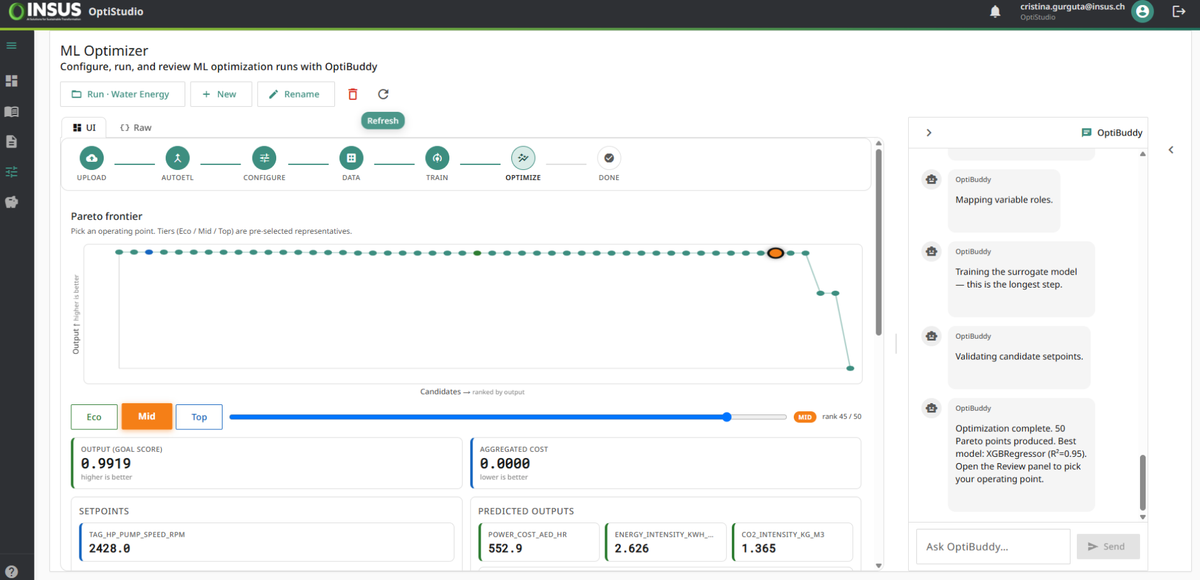
Step-by-Step Workflow in Production
OptiStudio executes a continuous, 7-phase closed-loop advisory workflow:
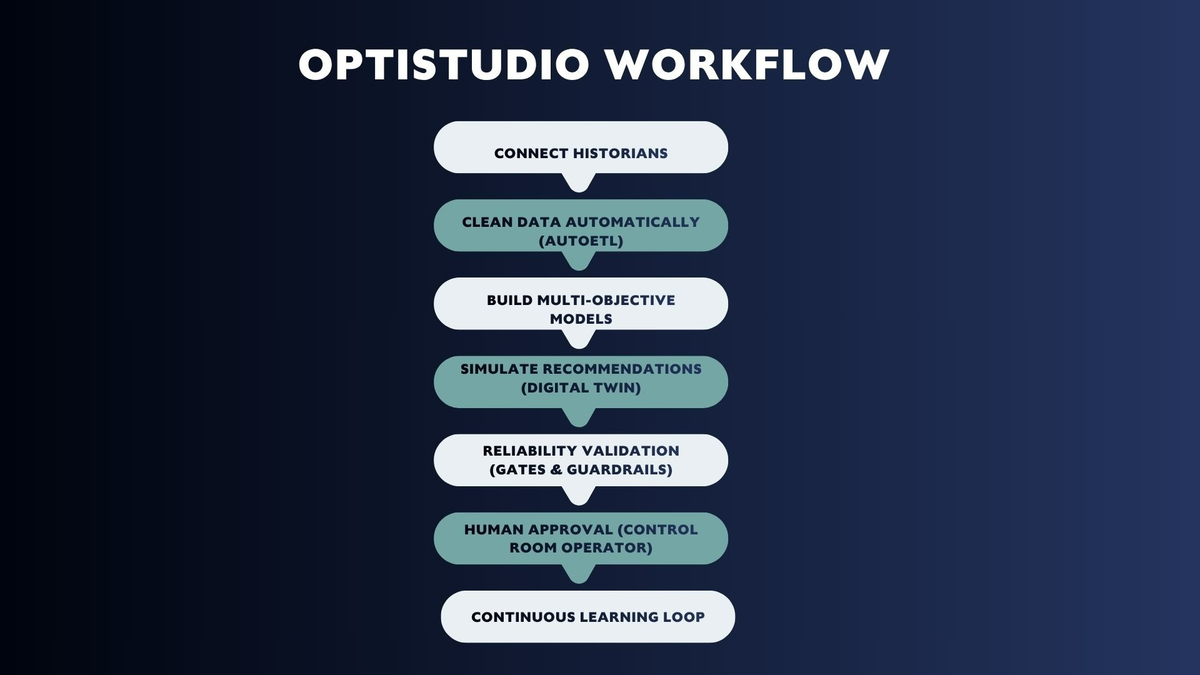
- Connect Historians: Non-intrusive integration reads live operational tags directly from existing plant infrastructure (e.g., OSI PI, Aspen IP.21, SCADA).
- Clean Data Automatically: AutoETL parses noise, fills missing data values, normalizes parameters, and aligns disparate timestamps automatically.
- Build Optimization Models: Multi-objective Bayesian algorithms map active process variables against economic, energy, and throughput constraints.
- Simulate Recommendations: Digital twin modules run continuous scenario checks to calculate expected power savings and process stability outcomes.
- Reliability Validation: Algorithmic gates verify that recommendations remain strictly within defined safe operating envelopes and equipment design limits.
- Human Approval: Recommendations populate the operator interface with reasoning context; control room personnel retain final execution authority.
- Continuous Learning: Closed-loop feedback ingests real-world performance results post-adjustment, continuously refining model precision over time.
AI Safety & Governance
Is AI safe to deploy in mission-critical process industries?
Yes, because OptiStudio isolates its AI models within a supervisory advisory layer, enforcing physical constraint gates and keeping control-room operators strictly in charge of execution.
Industrial leadership frequently cites operational safety and risk mitigation as top prerequisites for software deployment. OptiStudio is engineered around explicit safety guardrails:
- Human-in-the-Loop Architecture: The AI functions strictly as a decision-support advisory system. Recommendations require human review before any change impacts the plant floor.
- No Direct PLC Control: Automatic write-back into direct control loops is structurally prohibited by system architecture, preventing autonomous system overrides.
- Reliability Gates: Physics-based constraints enforce operational boundaries (e.g., maximum pressure limits, temperature thresholds, vibration tolerances) to block out-of-spec actions.
- Audit Trail & Compliance: Every recommended setpoint, operator action, rejection reason, and resulting plant behavior is logged for regulatory and internal audit requirements.
- Explainable AI (XAI): Rather than outputting "black-box" numbers, recommendations include context detailing why an adjustment was suggested and how it aligns with established plant SOPs.
- Cybersecurity Compliance: Designed to comply with IEC 62443 standards and enterprise IT/OT segregation requirements, protecting core control networks against external vulnerabilities.
Expected ROI & Quantified Business Impact
OptiStudio generates immediate, verifiable bottom-line value by cutting power demands and optimizing input-to-output ratios without capital expenditure:
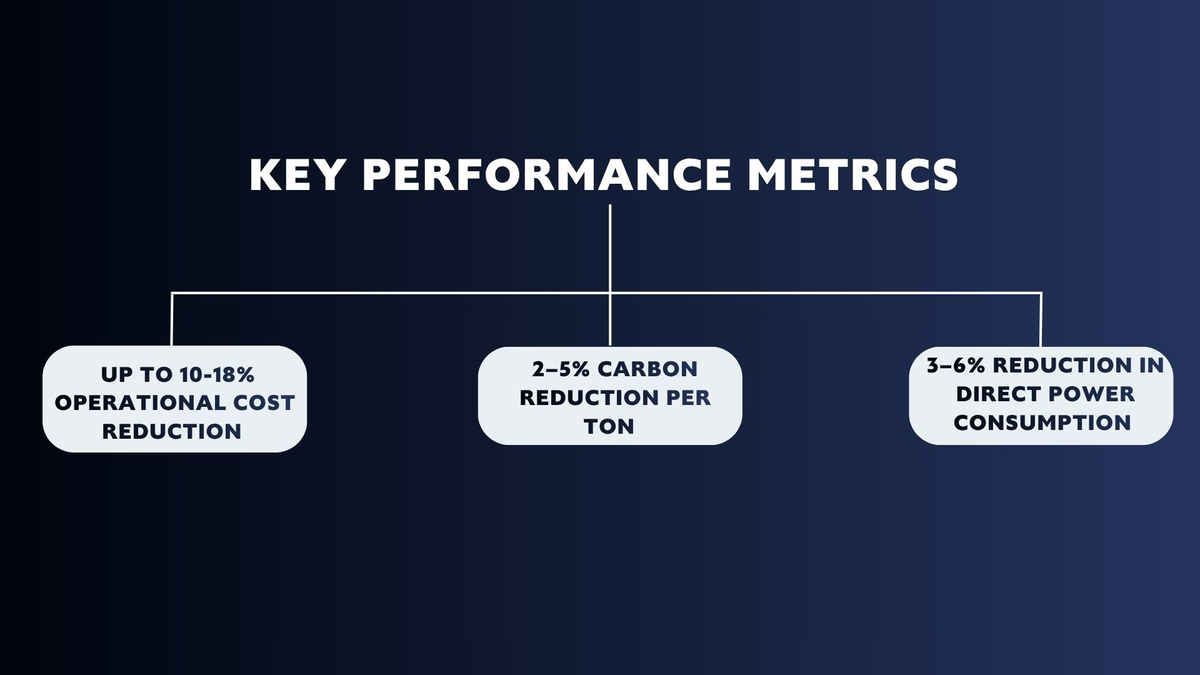
- Up to 10% Overall Operational Cost Reduction (lower fuel burn, reduced peak power demand charges).
- Up to 18% Peak Efficiency Gains across targeted deployments.
- 3–6% Power Usage Reduction across motor drives, pump configurations, and thermal equipment.
- 2–5% CO₂ Intensity Reduction per unit of output (supporting ESG metrics and CSRD compliance).
- Improved Process Stability: Reduced variance across core parameters, preventing unplanned shutdowns.
- Faster Optimization Cycles: Engineering teams spend less time manually analyzing historian logs and more time acting on predictive operational recommendations.
Industry Applications
OptiStudio provides targeted value for sectors operating high-energy process loops governed by multi-variable physical constraints.
- Utilities & Desalination (SWRO): Optimizes high-pressure feed pumps, energy recovery devices (ERDs), and pump staging sequences to reduce specific energy consumption (kWh/m³) while preserving target water yield and salinity standards.
- Cement Manufacturing: Predicts real-time compressive strength to balance raw mix inputs, stabilize kiln temperatures, optimize grinding circuits, and lower clinker factors.
- Chemical Processing: Optimizes thermal balances, reactor feed rates, and distillation tower pressures to balance energy draw against chemical yield specifications.
- Steel & Metallurgy: Manages furnace thermal cycles, electrical power draws, and fuel ratios to minimize energy intensity during melt and refining operations.
- District Cooling: Optimizes chiller plant configurations, variable frequency drive (VFD) speeds, and chilled water supply temperatures relative to ambient weather forecasts and thermal demand.
- Mining & Mineral Processing: Reduces kilowatt-hour consumption per ton of processed ore across grinding, crushing, and slurry pumping operations.
- Petrochemicals: Balances heat exchanger networks, steam distribution lines, and continuous cracking operations for optimal energy utilization.
Fitting Into Your Existing Systems
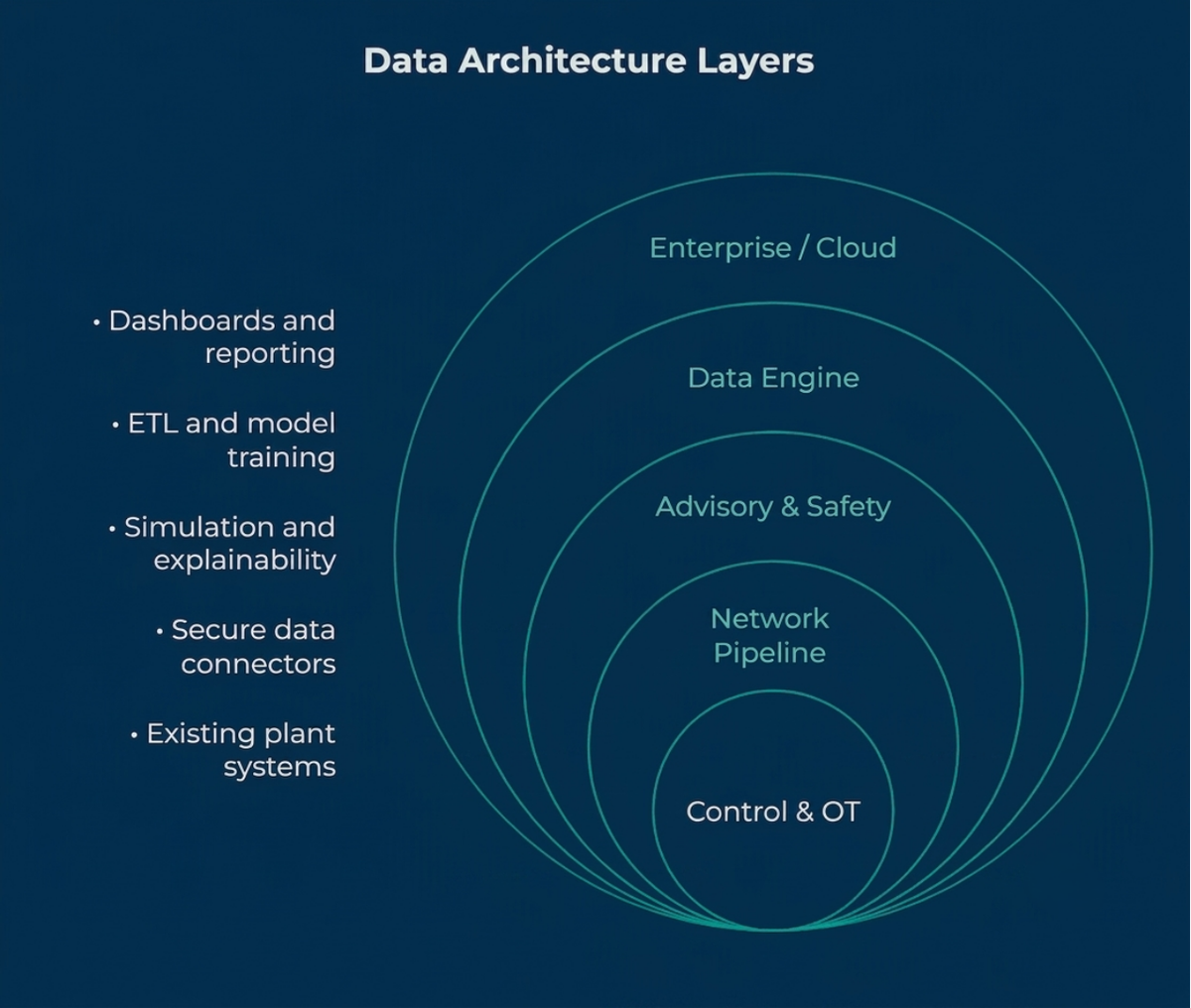
OptiStudio connects at the supervisory level through secure, read-only industrial pipelines, preserving existing IT/OT network segregation.
Frequently Asked Questions
What is industrial AI optimization?
Industrial AI optimization is the application of machine learning algorithms to continuous process environments to adjust operational variables automatically or semi-automatically for maximum cost, energy, and throughput efficiency.
Can AI control my plant directly?
No, OptiStudio operates as an advisory supervisory layer that outputs recommended setpoints to operators rather than executing direct control overrides.
Does OptiStudio replace OSI PI?
No, OptiStudio integrates with OSI PI by reading its time-series data streams via AutoETL to power predictive models.
Does it work with Aspen IP.21?
Yes, OptiStudio features native integration capabilities designed to ingest operational tags directly from Aspen IP.21 data stores.
How long does deployment take?
Initial connectivity, AutoETL mapping, and model training are typically accomplished within a 4-to-8-week timeframe.
How is ROI calculated?
ROI is calculated by comparing post-deployment energy intensity against pre-deployment baseline operational data using IPMVP measurement methodologies.
Does OptiStudio reduce CO₂ emissions?
Yes, by optimizing energy usage and fuel burn rates, OptiStudio directly reduces Scope 1 and Scope 2 emissions per unit of production.
Can it optimize multiple objectives simultaneously?
Yes, OptiStudio uses multi-objective Bayesian optimization to optimize trade-offs between energy consumption, production volume, and product quality.
Is it compatible with IEC 62443?
Yes, OptiStudio's system architecture aligns with IEC 62443 standards to maintain secure IT/OT network segregation.
How does OptiStudio handle missing or noisy sensor data?
OptiStudio’s AutoETL pipeline automatically filters telemetry noise, fills data gaps, and cleans tag streams before data reaches the modeling engine.
Does OptiStudio require hardware replacement?
No, OptiStudio sits on top of existing sensors, PLCs, historians, and DCS installations without requiring hardware retrofits.
What role does the operator play in daily usage?
Control room operators review generated setpoint adjustments on a dedicated dashboard, accepting or rejecting suggestions based on real-time operational context.
What happens if an operator rejects a recommendation?
The system logs the rejection reason, providing feedback to refine future optimization models.
Can OptiStudio run on-premise?
Yes, OptiStudio can be deployed entirely on-premise, in cloud environments, or via a hybrid setup.
How does OptiStudio prevent equipment damage?
Integrated Reliability Gates enforce physical operating limits, preventing the generation of setpoints outside safe tolerances.
Why choose INSUS as your industrial AI partner?
INSUS acts as an industrial AI execution partner, combining domain engineering expertise with production-grade software deployment models.
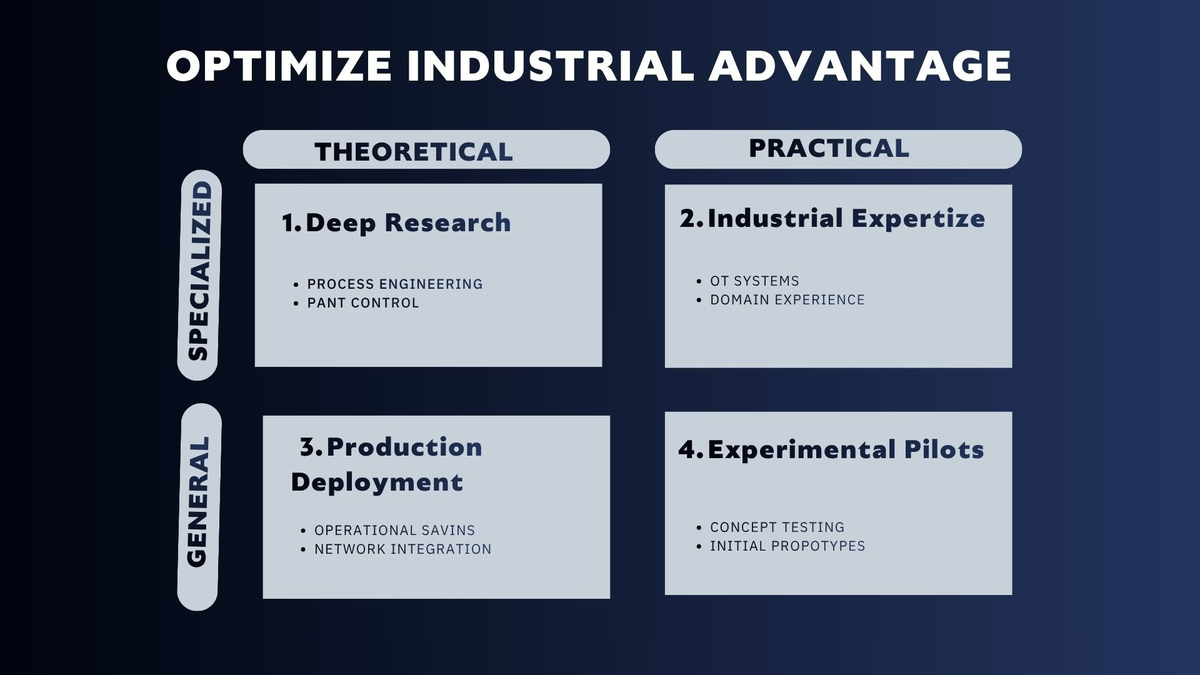
- Industrial Expertise: Our engineering teams understand real-world process constraints, thermal dynamics, and OT realities—not just algorithm code.
- AI Execution Focus: We bridge the gap between experimental concepts and fully operational systems running on the plant floor.
- Legacy Infrastructure Fit: OptiStudio connects to existing operational hardware and software without requiring CapEx overhauls.
- Gain-Share Pricing Model: Under our Gain-Share model, INSUS shares performance risk by tying fees to verified financial savings.
Get Started with OptiStudio
Take the next step toward optimizing your facility's energy efficiency:
- Talk to Our Engineers: Connect with our industrial AI experts to discuss your operational challenges and identify the best optimization strategy for your facility.
- Explore OptiStudio: Learn how OptiStudio helps industrial teams improve efficiency, reduce energy consumption, and optimize plant performance.