
How to Make Change Work: Applying the ADKAR Model in Organizations
Organizational change fails when people don’t adopt it. This article explains how the Prosci ADKAR Model helps organizations manage the human side of change by guiding individuals through awareness, motivation, skill-building, and long-term reinforcement.
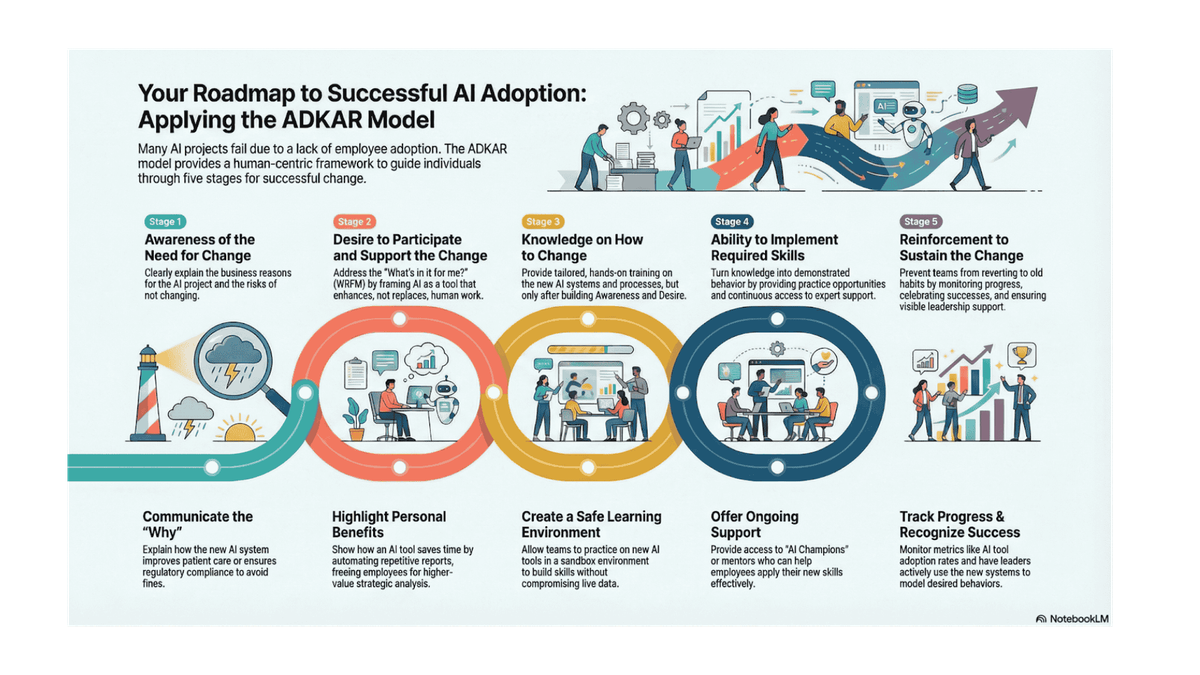

The Prosci ADKAR Model is a framework designed for managing individual change within an organization, based on the fundamental premise that organizational change begins when individuals successfully adopt new ways of working. It acts as a guide for individuals navigating a particular change, helping them address and overcome common roadblocks that lead to resistance,.
ADKAR is a core component of the Prosci Methodology, providing a structured, repeatable, and adaptable approach for managing the human aspect of change,.
How the ADKAR Model Works
The ADKAR model is an acronym representing the five building blocks necessary for successful individual change:
- Awareness
- Desire
- Knowledge
- Ability
- Reinforcement
How Companies Can Adopt the ADKAR Model
Organisations adopt the ADKAR model by systematically implementing strategies corresponding to each of the five building blocks, ensuring that employees are prepared for and actively engaged with the change.
1. Awareness (A)
The initial step requires establishing a clear understanding among team members of the reason for the change—the "why".
- Explain the Rationale: Outline the necessity of the change and explain what will happen if it is not implemented, highlighting the risks such as costly fines, rework, and reputational damage (e.g., noncompliance in financial services).
- Targeted Communication: Ensure that the right people share the key messages; typically, employees prefer to receive personal-impact messages from their supervisors, while organizational messages should come from business leaders.
- Individual Impact: Provide the necessary support and resources for employees to understand how the change impacts them individually.
2. Desire (D)
Once employees understand the necessity of the change, the next focus is creating a compelling case for participation to increase their willingness to move forward.
- Answer WIIFM: Address the critical question, "What's in it for me (WIIFM)?" by explaining the personal benefits (e.g., how a new ERP system will save time, eliminate bottlenecks, and speed up vendor payments).
- Provide Evidence: Share relevant case studies to demonstrate where the change has already made a positive impact and to back up the claims being made.
- Incentivise Adoption: Use incentives or recognition programmes to foster a willingness to support and participate in the adoption of new requirements.
3. Knowledge (K)
The Knowledge phase focuses on ensuring employees know how to perform effectively in the future state. It is important to note that initiating the change journey with training, effectively skipping Awareness and Desire, is a common mistake, as employees lacking A and D are unlikely to have a learning mindset.
- Identify Skills Gaps: Determine where employees need new training by reviewing HR documentation and discussing current abilities.
- Tailored Training: Communicate precisely how the change impacts individuals and provide unique training and resources tailored to different groups (e.g., separating front-line workers from in-plant office admins in manufacturing)
- Safe Learning Environment: Deliver hands-on, interactive training in a safe environment to prevent issues such as the compromise of customer or patient data.
4. Ability (A)
Ability is the stage where the desired change is demonstrated in behaviours and mindsets, fulfilling the successful outcomes defined at the start of the initiative.
- Hands-on Practice: Give team members opportunities to implement their training and practice new skills during the learning process (e.g., allowing practice on a new CRM system).
- Expert Support: Ensure continuous access to expert advice, training documentation, or mentorships to help employees successfully execute the change.
5. Reinforcement (R)
Because people naturally tend to revert to past, comfortable patterns, the Reinforcement stage is essential for sustaining the change over time and preventing slippage back into old ways.
- Monitor Progress: Define specific success metrics (such as reduced setup time or decreased data privacy breaches) and actively track them to ensure the change stays on course.
- Engage Leadership: Active and visible support from senior leaders is critical; they must endorse the change as an integral part of the organization to encourage widespread follow-through.
- Feedback Loops: Use feedback mechanisms, such as team member surveys, to track progress, identify necessary corrective actions, and reinforce the new ways of working (e.g., using a 360-degree feedback system).
Organisations benefit significantly from adopting the ADKAR model by following a structured approach to change management, which ensures that leaders and employees are equipped to adapt quickly to new processes, ultimately leading to higher success rates for projects and initiatives,.