
Beyond the Hype: 4 Surprising Reasons Your AI Investment Isn't Paying Off
Despite record-breaking global spending on AI, many organizations are failing to achieve meaningful ROI. This article uncovers four unexpected reasons behind the “AI Impact Gap” from unrealistic timelines to organizational bottlenecks and reveals what true AI ROI leaders are doing differently to turn hype into transformation.
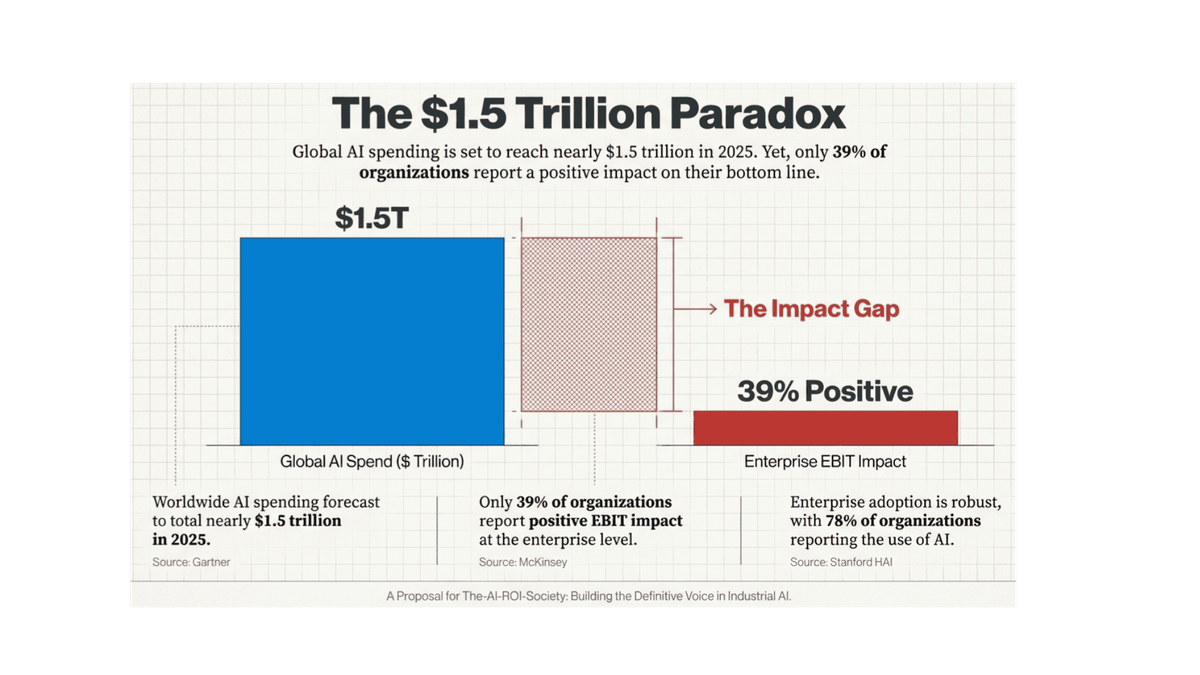

Global spending on Artificial Intelligence is on a staggering trajectory, forecast to reach nearly $1.5 trillion in 2025. In boardrooms and on earnings calls, the pressure to adopt, integrate, and scale AI has never been higher. The hype suggests that any organization not pouring capital into AI is already falling behind.
But a starkly different reality is emerging from beneath the buzz. Despite this spending frenzy, a large number of organizations are struggling to see meaningful, enterprise-level returns on their AI investments. This disconnect between massive expenditure and elusive impact is creating a paradox that leaders can no longer ignore. One executive captured the mood perfectly: “Everyone is asking their organisation to adopt AI, even if they don’t know what the output is. There is so much hype that I think companies are expecting it to just magically solve everything.”
Executive, Telecommunications, Media & Technology Company
If your organization is investing heavily in AI but failing to see a material impact on the bottom line, you are not alone. This article reveals four surprising, counter-intuitive truths that explain this "Impact Gap" and what leaders can learn from the organizations that are getting it right
Your Payback Period is Longer Than You Think—Much Longer
The first hard truth of AI value is that it defies the timelines of traditional technology investments. In most enterprise IT projects, executives are conditioned to expect a return on investment within 7 to 12 months. AI does not operate on this schedule.
Research shows that the majority of organizations report achieving satisfactory ROI on a typical AI use case in two to four years. This extended timeline fundamentally breaks traditional IT funding models and forces a shift from project-based thinking to a sustained strategic commitment, a change many CFOs are unprepared for.
Even more telling is the data on short-term wins. A tiny fraction of organizations just six percent reported seeing returns in under a year. But this grueling timeline isn't just a feature of the technology; it’s a symptom of a deeper strategic error that many organizations are making right now.
You’re Chasing Efficiency, But Leaders Are Chasing Reinvention
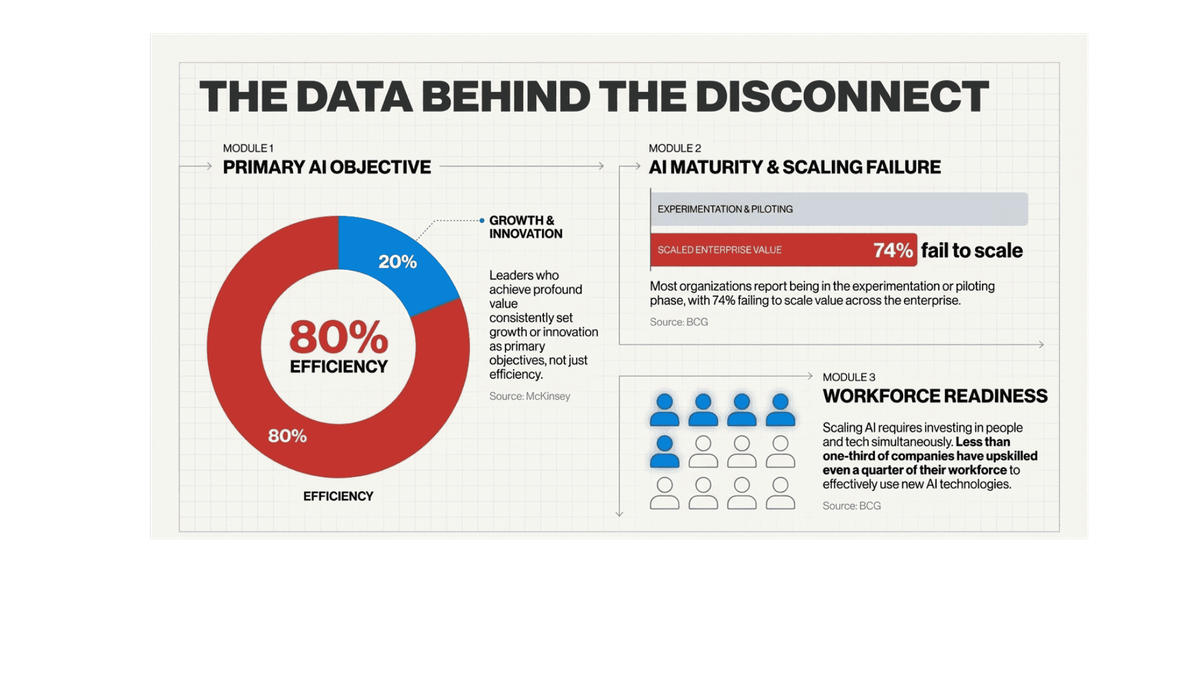
Herein lies the central paradox of AI ROI: organizations are aiming at the wrong target. An overwhelming majority eighty percent set efficiency as their primary AI objective. Yet, despite this laser focus on cost-cutting, only 39% report a positive EBIT impact at the enterprise level. This is because many are pursuing scattered, low-value efficiency gains outside of the functional areas where over 65% of potential GenAI value is concentrated: Sales, IT, and Supply Chain. The incremental savings from these fragmented efforts are often absorbed by the organization, failing to move the needle on overall profitability.
The verdict is in: while AI is a capable efficiency tool, its transformational value is unlocked when it's used for growth. High-performing "AI ROI Leaders" define their critical wins in strategic terms, targeting the “creation of revenue growth opportunities” (50 per cent) and “business model reimagination” (43 per cent). This strategic miscalculation choosing incremental cost-cutting over foundational reinvention points to a more fundamental problem. The real bottleneck isn't a flawed strategy, but an organization incapable of executing a bold one.
The Bottleneck Isn't Your Technology, It's Your Organization
When AI initiatives fail to scale, it's rarely a failure of the technology. The true bottleneck is almost always the organization itself. The adoption of AI is analogous to the historic industrial transition from steam power to electricity. True value wasn't realized by simply replacing a steam engine with an electric motor; it required redesigning entire factories, workflows, and supply chains around the new power source.
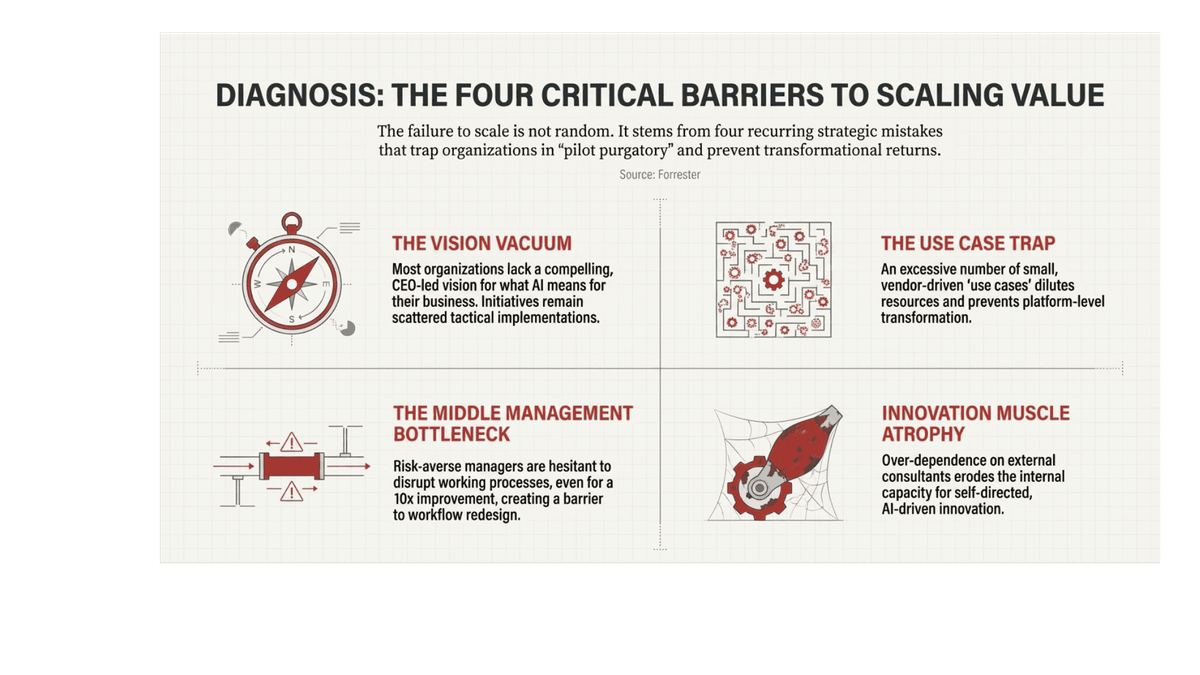
The same is true for AI, where the primary barriers holding back ROI are deeply organizational:
- The "Vision Vacuum": Many companies lack a compelling, executive-led strategy for what AI means for their business. This vacuum is a direct consequence of a failure in executive ownership. In high-performing "AI ROI Leaders," the CEO is increasingly the primary owner of the AI agenda (10% of organizations), ensuring that AI is treated as a strategic imperative, not just an IT project.
- The "Middle Management Bottleneck": Middle managers, often risk-averse and tasked with maintaining stable processes, can inadvertently block the disruption required for transformation. As Frederic Giron, VP and Senior Research Director at Forrester, articulated in Why AI ROI Remains Elusive Despite Widespread Adoption article:
"No manager wants to take responsibility for saying, 'This process that’s working fine today? We’re going to stop doing it this way and try something completely new because I’m confident AI can help us do it 10 times better.'"
Successfully deploying AI requires executive courage and a commitment to deep organizational change. Overcoming these hurdles is a race against time, because the one advantage early movers once had—access to superior technology—is rapidly disappearing.
The Best AI Is Becoming a Commodity and That Changes Everything
Perhaps the most surprising truth is that access to powerful, state-of-the-art AI is rapidly ceasing to be a competitive advantage. The technology is being democratized and commoditized at an astonishing speed.
Consider these data points:
- The cost to use advanced models is plummeting. The inference cost for a system at the GPT-3.5 level dropped over 280-fold between late 2022 and late 2024.
- The performance gap between proprietary "closed" models and high-performing "open-weight" models is shrinking so fast that it's becoming negligible for many business applications.
As the underlying technology becomes cheap and universally accessible, the only sustainable source of competitive advantage shifts. It no longer matters what AI you have; it matters how you use it. As technology becomes a commodity, the only defensible moat is organizational excellence. This transforms the challenges of the "Middle Management Bottleneck" and the "Vision Vacuum" from mere obstacles into the central competitive battleground.
Winning the Real AI Race
The uncomfortable truth is that while most leaders wait two to four years for a return on scattered efficiency plays, the commoditization of AI means their competitors are already redesigning their entire business model. Achieving a meaningful return on AI investment is not a technology puzzle; it is a strategic and organizational one. The real race isn't about payback; it's about reinvention before the technology becomes table stakes.
The organizations generating real, transformational value treat AI as a fundamental business transformation, not an IT project. They are disciplined, focusing on a few high-impact areas where they can reimagine their business. And they are patient, committing to the long-term, difficult work of organizational change.
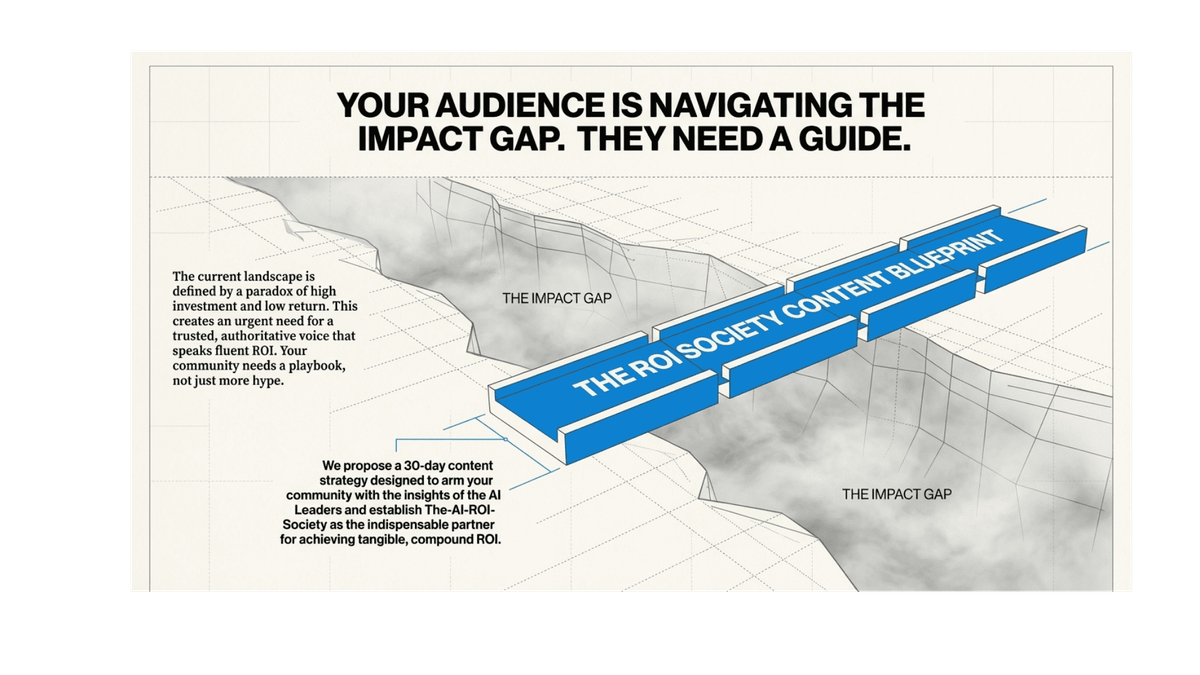
Your competitors have access to the same powerful AI. The one thing they don’t have is your organization. In the race for AI value, is it your greatest asset or your biggest liability?