
AI’s Sustainability Paradox: Is the Energy Cost Worth the Climate Fix?
A deep dive into the paradox discussed at Watershed’s AI Summit: while AI consumes more energy, it’s also becoming the most powerful tool for solving complex sustainability and Scope 3 challenges at scale.


Watershed conference summary
There's a fascinating duality in the sustainability world: the same technology raises concerns about energy consumption while simultaneously unlocking unprecedented opportunities to address sustainability's biggest challenges. That technology is Artificial Intelligence (AI).
We recently attended the AI Summit conference, hosted by Watershed, where leaders from Anthropic, climate science, and manufacturing industries gathered to explore this paradox. While AI's electricity consumption is projected to double by 2030 (IEA, 2025), Dr. James Joyce, Watershed's sustainability science lead, pointed out that this represents only 1.5% of global electricity consumption, significantly less than industry (3x more) and electric vehicles (1.5x more) will require in the same period.
The critical question isn't how much energy AI consumes, but what this consumption enables.
Jonah Cool from Anthropic's Beneficial Deployment team highlighted a dichotomy many companies face with high-complexity, scale-dependent problems: choosing between accuracy or scale.
Carbon footprinting exemplifies this challenge. Accurate predictions require long, costly, product-specific life cycle assessments (LCAs). Predictions at scale rely on generic proxy data, leading to uncertain actionable insights. AI systems bridge this gap by decomposing products into individual components and manufacturing stages, inferring carbon footprints, and identifying emissions hotspots, practically instantaneously and cost-efficiently.
Manufacturing experts shared compelling examples:
- Nadia Carol (Specialized Bicycles) uses AI to analyze their entire product line, measuring footprint differences between mechanical and electronic-gear shifting
- Georgina Taylor (Vita Group) enabled fair comparative analysis of supply chain footprints, revealing that biomaterials aren't always better from a land and energy use perspective
- Anna Yates (Albany International) identified misconceptions about transportation emissions, redirecting efforts toward higher-impact areas like raw materials and manufacturing energy
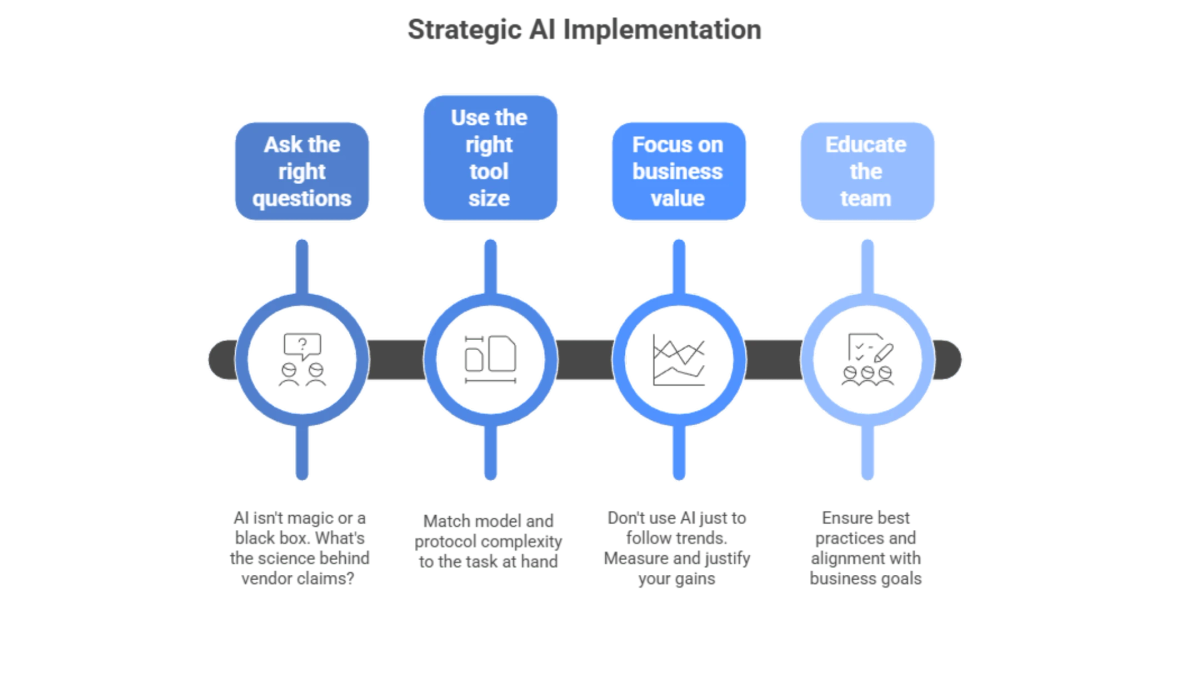
The summit offered clear guidance for sustainability leaders approaching AI adoption:
- Ask the right questions: AI isn't magic or a black box. What's the science behind vendor claims? What's their energy efficiency strategy? Demand evidence and transparency
- Use the right tool size: Match model and protocol complexity to the task at hand
- Focus on business value: Don't use AI just to follow trends. Measure and justify your gains
- Educate the team: Ensure best practices and alignment with business goals
Following Anthropic's philosophy, the goal is to compete both on model performance and on responsible, fair application and distribution. This requires:
- Conducting thorough analyses of AI impact on and adoption by different societal and industry sectors
- Publishing science-based impact research
- Being transparent about constraints, concerns, and limitations—not just success stories
- Keeping humans in the loop to augment, not replace, human capacity
Looking ahead, panelists predict that within two years:
- Carbon footprint information will become standard for consumer products
- Carbon footprint measurement will become more dynamic, potentially adjusting to real-time grid composition
- Supplier assessment will be based on emissions impact instead of spend
- Data management will shift to a background task rather than the primary job
sources should remain. But it needs contextualizing, especially when recognizing the scalability challenges of current pressing sustainability issues, like Scope 3 emissions, which represent 80-90% of most companies' footprints (McKinsey, 2024).
While we should consider whether we can afford the energy cost of AI in sustainability work, we must also ask: Can we afford to leave our most powerful analytical tools on the shelf while emissions continue to rise?
Interested in learning more about sustainability-aware AI solutions and how it might apply to your organization's sustainability strategy? Contact us at info@insus.ch. The technology is evolving rapidly, and early adopters are already seeing results that were unimaginable just a year ago.